

Staff who have only previously used gas or ceramic cooking can easily pick up habits that lead to problems when using an Induction cooker. If staff are shown how to use the cooker correctly in the first week of their employment then burnt pans and waste can be avoided.
Check For The Magnetic Base Symbol
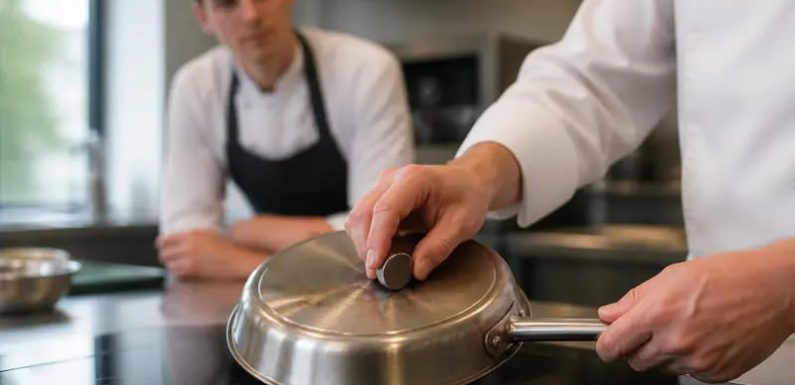
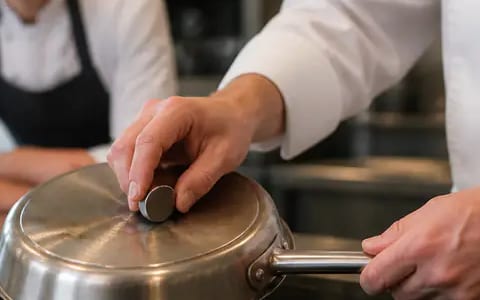
Induction only works with pans that have a magnetic base. Therefore new staff need to be shown the small magnet symbol on the underside of all compatible pans. New staff should also be shown how to check for suitable pans before placing them on an induction zone. A simple way of checking is to hold a fridge magnet against the base of the pan – if it sticks then the pan will work on an induction zone.
Teach Power Levels Properly
The way one controls heat from a gas stove does not translate to an induction stove. Be sure to show staff how each of the levels (typically 1-9) on the control panel of a commercial induction stove affects the cooking of food. Make up some house terms for low simmer, steady fry, full blast etc. to make for easy reference on the line.
Explain The Ghost Burner Scenario
One of the most common errors that staff make in using commercial induction ranges is not understanding that it is the pan that is not working (e.g. not having a magnetic base) rather than it being a fault with the range. Run through the ‘Ghost Burner’ scenario in your staff induction, test out different pans, how they are placed on the zone and most likely come to the conclusion that it is a pan problem rather than a range problem.
Cover Safe Pan Handling
As the heat is generated within the pan, induction cooking areas are cool to touch but the bottom and handles of pans on induction cooking areas will heat up as fast as they would on other types of cooking areas. So although the cooking area itself is cool to touch, staff will need to use cloths, gloves, etc. as they would for other types of cooking surfaces. A cool looking cooking area does not necessarily mean a cool cooking area.
Build In Clean-As-You-Go Habits
Spills and splashes on the glass surfaces of induction cooking can scorch on in minutes – particularly sugary or starchy types of spill. These need to be wiped down immediately after each use to prevent marking the glass. A soft scrubber and a safe glass cleaner should be left at each cooking zone for prompt cleaning of any spillages to prevent lasting marks – some of which can be impossible to remove from the glass surfaces.
Set A Rule For Error Codes
Ensure that staff know what to do if a zone on an induction hob fails to switch on and/or displays an error code. Inform staff to report the fault to the shift supervisor and have it logged on a whiteboard (or similar) for the following shift’s reference. This is more important on busy lines as the faults could result in part of the kitchen not being able to function at the busiest time.
Use A Simple Handover Checklist
A simple handover checklist can be used to ensure consistency within a kitchen, especially for staff who work part time or are agency staff and only work on a kitchen on a few shifts a month. A simple checklist can cover surfaces wiped, cleaned and left to cool, all pans of the correct size for the zone, any faults reported, and all zones switched off with all power levels set to zero. This will only take a couple of minutes to go through but can pick up small issues that could cause bigger problems on subsequent shifts.
Name Someone To Own Refresher Training
It is important to assign someone as responsible for giving out refresher training should the commercial induction ranges be changed over (replaced with new ones) or if there are going to be changes to the controls etc. on new ranges. Most likely to give out refresher training on Commercial Induction Ranges would be the head chef or the kitchen manager.
For Commercial Induction Range, visit Commercial Induction ranges from Target Catering.
Induction cooking does not have to be complicated. Induction cooking just needs to be consistently good. A few good habits consistently applied from the start of induction right through to the handover at the end of service will prevent problems with service developing from small misunderstandings.
