

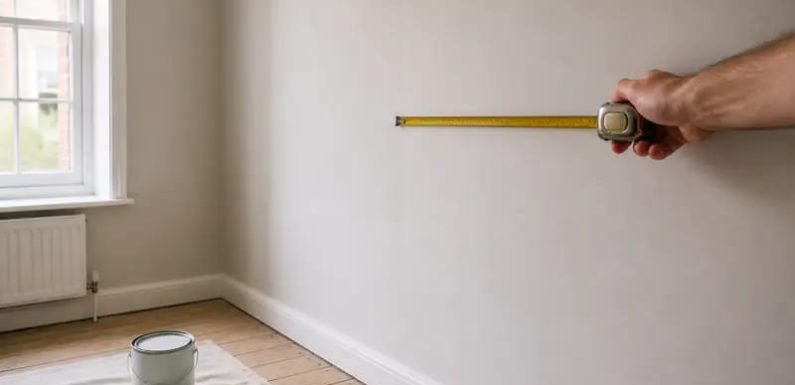
Buying paint by guesswork tends to end in one of two ways – either a return to the store for a top-up tin that doesn’t quite match the rest of the paint or those tins left in the shed for years, slowly drying up! It only takes a few minutes to calculate your requirements with a tape measure and a calculator.
Measure The Walls First
First calculate the perimeter of the room, then multiply by the height. For example, for a 4m x 3.5m room with a 2.4m ceiling, the perimeter is 15m and 15 x 2.4m equals 36m square of wall space. Remember to measure up the full height of the wall even if there is a wardrobe or bed pushed against it as you will still need to paint the areas behind. Many small accidents occur when shifting furniture to get tape measures into corners of rooms. A tin of paint dropped on a bare foot can cause serious pain and according to the NHS can lead to severe toe pain. So take your time and make sure your feet are protected by your shoes while you are measuring up.
Subtract Doors And Windows
The area of the walls to be painted less the area of the doors and windows. A typical internal door opening has an area of about 1.6m2 to 1.8m2. Average size windows have an area of about 1m2 to 1.5m2. If there are larger bay windows or double doors then measure each opening to get the correct figure. This is the biggest error people make when buying paint, they assume that all walls are covered in solid plaster when in fact a large proportion of the walls in a typical room are actually covered in glass and/or door frames.
Know Your Spreading Rate
When choosing a finish for your walls, remember that each will cover a different surface area. This is typically quoted on the tin, but there can be a big difference between emulsions, with matt covering 12-14m² per litre, silk and other ‘sheen’ finishes around 10-12m² per litre and trade/contract emulsions sometimes achieving up to 16m² per litre.
New Plaster Needs A Mist Coat
New plaster needs a different approach altogether and a mist coat applied first, and this needs to be diluted to a very thin solution (10 – 20% water and paint) and applied in full coverage to allow for good soakage. The coat needs to be allowed to fully dry for a minimum of 4 – 6 hours, preferably overnight before further coats are applied. If you are repainting a period property then it would be worth checking the repainting of older properties advice for more specific information on the particular type of plaster and/or lime-based wall you are dealing with and the best approach to take.
Worked Example The Bedroom
Worked Example The Bedroom – 4m x 3.5m with 2.4m ceiling and bedroom door and window. The perimeter is 15m and so 15 x 2.4m = 36m2 of wall space. The door is 1.8m2 and the window 1.5m2. Therefore we subtract 1.8m2 + 1.5m2 = 3.3m2 from the 36m2 of wall space, giving us 32.7m2 of paintable surface area. For two coats of paint this means we have 65.4m2 to cover in paint. At 13m2 per litre for matt emulsion this would require 5 litres in total – 2.5 litres for the first coat and 2.5 litres for the second coat.
Converting To Tins
Yes, 5 litres will fill a 5L tin but then you need to consider the cut-ins, the filling of trim work etc and also the second coat will probably be more dense than the first coat. So for this room, it is advisable to purchase a 5L tin and then add a 2.5L tin to that making 7.5L in total. For a silk finish paint, you will be looking at a coverage of 10-12m2 per litre so for this room you will be looking at around 6 litres in total. However, this would still be purchased in the form of a 5L tin plus a 2.5L tin. Trade emulsion paints have a higher coverage rate and you may get away with purchasing just a 5L tin for this room with some litres to spare.
Working Out Wallpaper Rolls
A roll of wallpaper is typically around 10m long and 53cm wide and will allow 4 drops of a small pattern repeat to a ceiling of 2.4m high. Large pattern repeats (such as 64cm) will however need to be cut allowing for matching at joins. This results in significant reduction in the length of usable wallpaper. For this room approximately 8 rolls of small repeat would be required whereas a large repeat would need approximately 10 rolls. Always check the repeat size on the roll label before ordering.
Double Check Before You Buy
Use a paint and wallpaper calculator to check your calculations for purchasing paint and wallpaper before you go to the store to buy. This will not replace the work that you have done already measuring the room, but it will help to catch any little errors you may have made while calculating.
If you get the measuring right at the start of your decorating project then the rest of the job should go OK and you won’t have to make a hasty mid-coat trip to the shop for more paint, and you won’t be left with loads of spare paint at the end of the job.
