

Key Takeaways
- A vacuum works by creating low pressure inside, so outside air rushes in.
- The motor spins a fan, and that fan moves air to create suction.
- Filters trap dust and return cleaner air to your room.
- A full bag or clogged filter kills suction long before the motor struggles.
- Airflow in cubic feet per minute matters more than raw wattage.
- Regular maintenance keeps suction strong for years of weekly cleaning.
A vacuum cleaner feels like everyday magic. You push it across the floor, and dust simply vanishes. However, there is no magic inside. There is physics, engineering, and a surprisingly simple idea at the core. Every vacuum creates a pressure difference, and air rushes in to fill it. Dust rides that air current into the machine. Therefore, understanding your vacuum makes you a smarter owner. You will buy better, clean better, and fix small problems yourself. In this post, you will learn how suction actually works, what the motor does, and how filters protect the air in your home. Read on, because the machine you use weekly deserves ten minutes of explanation.
The Science of Suction: How a Vacuum Pulls Dirt
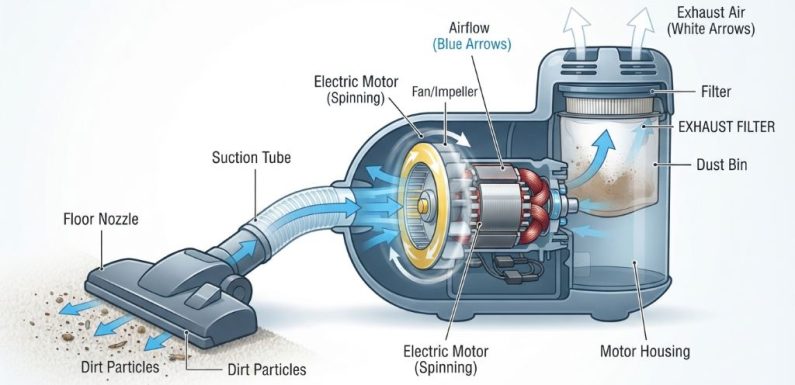
Suction starts with a pressure difference. The vacuum motor spins a fan at high speed. That fan pushes air out of the machine’s chamber toward the exhaust. As a result, the air pressure inside the chamber drops below the pressure of the room. Therefore, outside air rushes through the nozzle to fill the gap. Dust and crumbs ride that rushing air into the machine.
Think of it like drinking through a straw. You lower the pressure in your mouth, and the drink climbs to meet it. However, a vacuum works in reverse direction. The machine lowers pressure inside itself, and the room pushes air in. Consequently, a vacuum does not truly suck. The atmosphere pushes air into the space the fan emptied.
The strength of that flow depends on several factors working together:
- The fan speed and motor power.
- The seal quality of hoses and connections.
- The openness of the air path through filters and bags.
- The width and design of the nozzle.
Airflow measures how much air moves, often in cubic feet per minute. Suction strength, or water lift, measures how hard the machine can pull. Therefore, a good vacuum balances both numbers. Additionally, the sealed system matters, because leaks waste suction before it ever reaches your floor.
Agitation plays a supporting role. Bare suction lifts loose dust, but carpet fibers hold dirt stubbornly. Therefore, the spinning brush roll beats and lifts fibers so the airflow can carry dirt away. Consequently, a vacuum with a weak brush cleans carpets poorly, no matter how strong the motor is.
Finally, remember that blockages defeat physics. A clogged hose or a full bag changes the pressure balance. The motor keeps spinning, but the airflow dies. Therefore, most “weak vacuum” complaints trace back to blockages, not broken motors. Consequently, checking the air path is the first repair step for any owner.
Inside the Machine: Motors, Fans, and Airflow Paths
The motor is the heart of a vacuum. Most household motors are universal motors, which run on standard wall power and spin extremely fast. Typically, they spin the fan between 20,000 and 35,000 revolutions per minute. The fan blades pull air from the nozzle side and push it toward the exhaust.
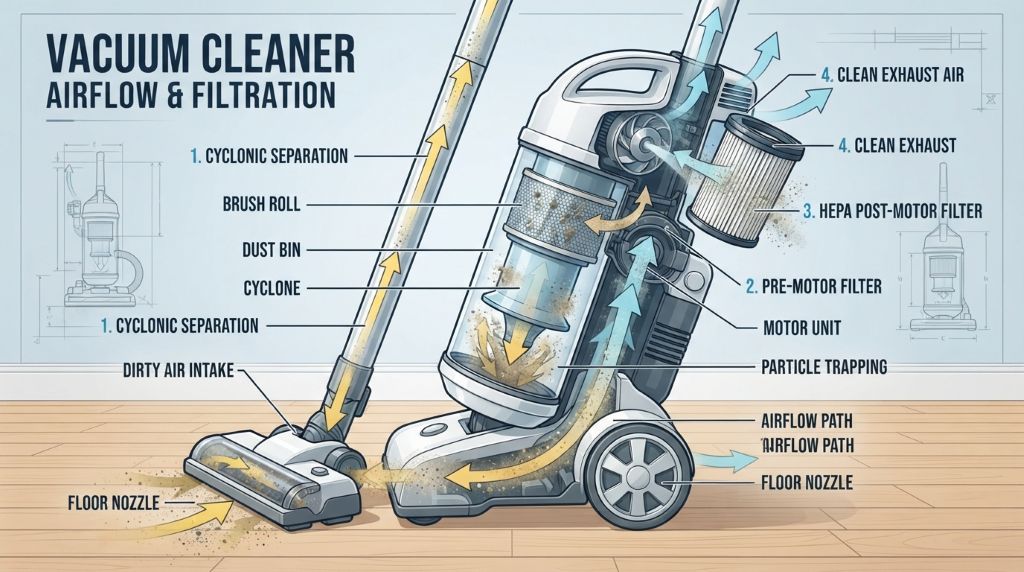
The airflow path follows a consistent route in almost every vacuum:
- Air and dirt enter through the nozzle or hose.
- The stream passes the brush roll area, where agitation loosens dirt.
- The air enters the dirt container or bag, which slows the air.
- Heavier particles drop out when the air slows.
- The air passes through filters toward the fan and motor.
- Clean air exits through the final exhaust filter.
That slowing step is the secret of separation. Fast-moving air carries particles, but slow air drops them. Therefore, the bag or container design deliberately widens the path to cut air speed. Consequently, dirt falls into the bin while air continues on. This is also how bagless cyclonic vacuums work, which spin the air in a tight circle. Centrifugal force throws dust against the walls, and it drops into the bin.
The motor needs protection from the dirt it never touches. Pre-motor filters stop fine dust before it reaches the fan and bearings. However, a worn pre-motor filter lets dust grind the motor bearings. Therefore, filter maintenance is motor maintenance. Additionally, motors overheat when airflow is blocked, because moving air carries heat away. Consequently, a clogged vacuum can literally cook its own motor.
Heat and carbon dust are the byproducts of universal motors. The familiar warm smell of a vacuum is motor brushes wearing on the commutator. Additionally, motor life depends on airflow quality and cooling. According to vacuum manufacturers, well-maintained motors commonly last several hundred operating hours, while neglected ones fail within a few years.
Finally, brush roll motors add another layer in modern machines. Driven brush rolls spin at a few thousand revolutions per minute and need their own belts or motors. Belts stretch and slip over time. Therefore, a brush that stops spinning usually means a stretched belt. Consequently, knowing these parts helps you fix the two most common failures yourself.
Filters: The Part That Protects Your Air
A vacuum’s job is not just removing dirt from the floor. It also decides what goes back into the air you breathe. Therefore, filters are the difference between a clean room and a dust storm. Every vacuum uses a staged filter system, where each stage catches smaller particles than the last.
The main filter types are:
- Pre-filter: catches large debris and protects the motor.
- Standard exhaust filter: traps medium dust before air exits.
- HEPA filter: captures 99.97 percent of particles at 0.3 microns.
- Washable foam filters: reusable barriers for coarse dust.
HEPA deserves special attention. True HEPA filters must capture 99.97 percent of particles that are 0.3 microns wide, which is a United States government standard. To picture that size, a human hair is roughly 70 microns wide. Therefore, HEPA traps pollen, dust mite waste, pet dander, and much fine household dust. Additionally, sealed HEPA systems prevent dirty air from leaking around the filter. Consequently, HEPA vacuums are strongly recommended for allergy sufferers.
The Environmental Protection Agency notes that indoor air often carries more pollutants than outdoor air, and fine particles are a known health concern. Therefore, a vacuum with poor filtration stirs dust back into the air it supposedly removed. However, a good filtration system returns cleaner air than the room started with. Consequently, filters affect health, not just cleanliness.
Maintenance keeps filters honest. Washable filters need rinsing and complete drying, usually monthly with regular use. However, paper filters need replacement on schedule, because washing destroys them. Additionally, a clogged filter chokes airflow before the filter stops catching dust. Therefore, calendar reminders for filter care pay for themselves.
Bags act as filters too. A full bag blocks airflow, which strangles suction and overheats the motor. Additionally, fine dust clogs bag pores long before the bag looks full. Consequently, replacing bags at two-thirds full keeps airflow strong. Therefore, the cheapest vacuum repair is often just a fresh bag.
Uprights, Canisters, and Robots: Same Physics, Different Packages
The core science never changes across vacuum types. However, the packaging changes what each type cleans best. Therefore, match the machine style to your home instead of chasing brand names.
Upright vacuums put the motor and bag in one tall unit. They push easily across large carpeted areas, and the brush roll does the deep carpet work. However, they are heavier on stairs and awkward under furniture. Additionally, bagged uprights hold more dirt before losing flow.
Canister vacuums separate the motor body from the cleaning wand. You pull the canister behind you while the wand reaches under beds and around corners. Therefore, canisters excel on hard floors, stairs, and above-floor cleaning. Additionally, canisters feel lighter in the hand, because the wand carries no motor.
Robot vacuums shrink everything into a low disc. They trade suction power for convenience, because their motors are small and batteries are limited. However, daily light cleaning keeps dust from accumulating at all. Additionally, modern robots map rooms and avoid obstacles. Consequently, a robot works best as a maintainer between deep cleans, not a replacement for a full-size vacuum.
Stick vacuums trade power for speed. They suit quick daily pickups on hard floors. However, their small bins and short battery life limit deep cleaning. Additionally, cordless models lose suction as the battery drains, according to consumer testing organizations like Consumer Reports. Therefore, sticks are supplements rather than primary machines for homes with carpet.
Choose by your floors, not by price alone. Carpets need strong airflow and a good brush roll, which points to uprights or powerful canisters. Hard floors need gentle suction and good filtration, which canisters and robots handle well. Additionally, pets change the math, because pet hair demands brush rolls designed not to tangle. Consequently, the right type for your home outcleans the wrong type at any price.
Conclusion
A vacuum cleaner is a pressure machine, a filter system, and a motor, all working in one pass. You now know that the fan creates low pressure, the room pushes air in, and the dirt rides the flow. Additionally, you know that filters protect both your air and the motor itself. Therefore, treat maintenance as the real performance upgrade, especially when you select a commercial vacuum cleaner for daily restaurant cleaning and need reliable performance throughout demanding cleaning tasks.
Empty the bin or replace the bag at two-thirds full, rinse washable filters monthly, and check hoses for blockages. These three habits keep suction strong for years. So grab your vacuum this week, check its filters, and give it the ten minutes of care it gives your home every week.
FAQs
Does more wattage mean better suction?
Wattage measures power use, not cleaning power. Airflow and sealed suction determine performance. Therefore, a well-designed 1,200 watt machine can outclean a poorly sealed 2,000 watt one.
How often should I replace vacuum filters?
Replace paper filters every three to six months with regular use. However, washable filters need rinsing monthly and full drying. Therefore, check your manual and set calendar reminders.
Why does my vacuum lose suction over time?
Almost always a clog or a full bag. Check the hose, the filter, and the dirt container first. Additionally, a stretched brush belt reduces carpet cleaning. Consequently, most suction losses are free fixes.
Are bagless vacuums better than bagged ones?
Each has strengths. Bagless saves bag costs and shows dirt levels. However, emptying them stirs dust, which bothers allergy sufferers. Therefore, bagged HEPA machines suit allergies best.
Do robot vacuums replace full-size vacuums?
Robots maintain floors daily but lack deep suction and bin capacity. Therefore, use a robot between weekly deep cleans. Additionally, carpets still need brush roll power from a full machine.
